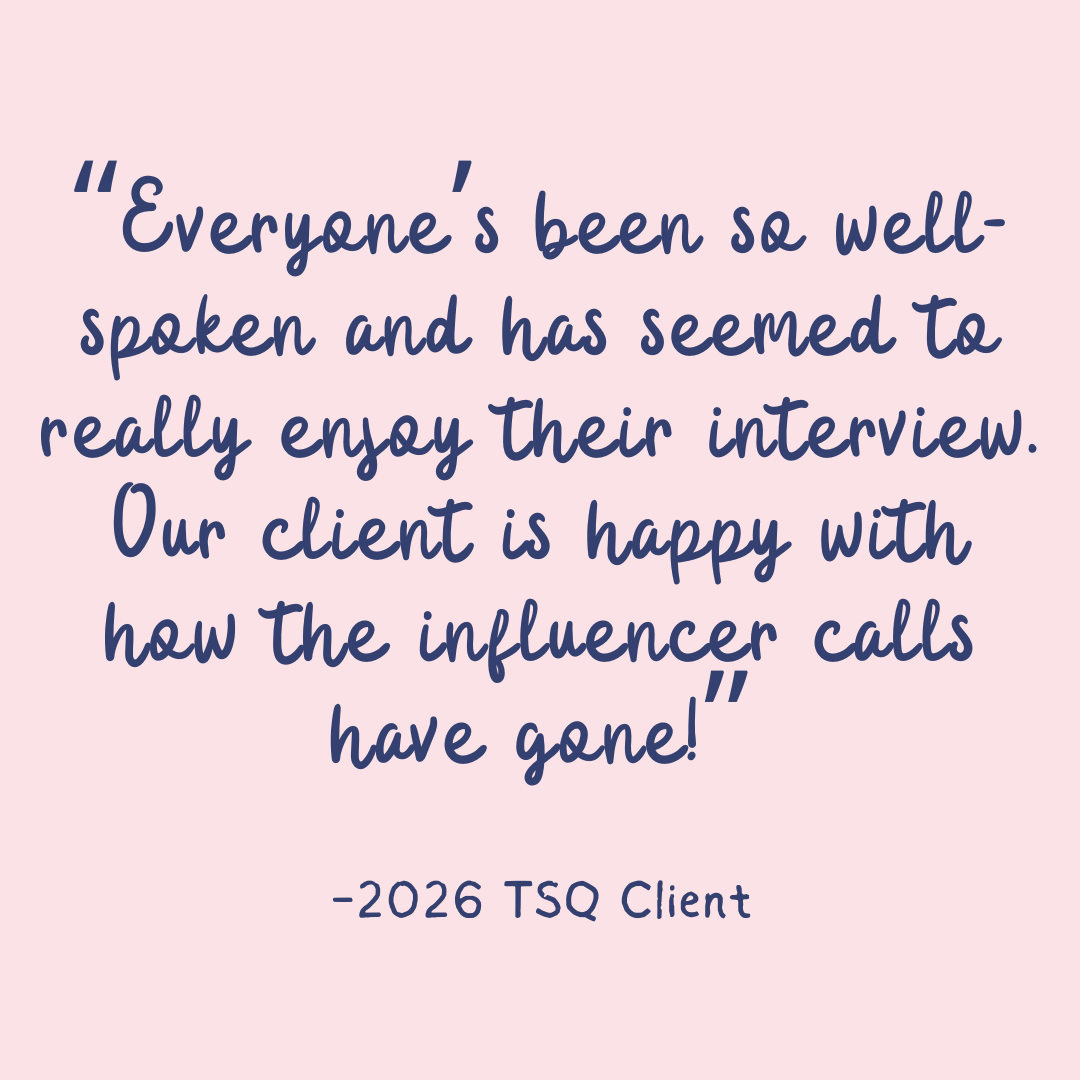
Direct quote from a 2026 first-time TSQ client regarding our influencer recruiting services.
If you've been in market research long enough, you've developed a mental shorthand for participant types. You know the general consumer recruit. You know the B2B session. You know the nuances of patient and healthcare work. These three buckets are distinct enough in methodology, recruitment, compensation, and sensitivity that most researchers can navigate them on instinct.
But there's a growing fourth type. And if you've tried to recruit influencers or creators using any of your existing processes, you've probably already figured out that something isn't working…you just might not have named why yet.
Over here at The Social Question, we’ve put a nametag to it.
Back up: The Existing Three Tiers
Before we get to the new one, let's define the framework clearly.
General Consumer is the broadest category. Participants are recruited as everyday users of products, services, or categories. They're findable through panels, social media ads, and screener surveys. Compensation is typically modest: a gift card or an incentive/honorarium. The barrier to entry is intentionally low. These are people sharing their experiences as ordinary buyers and users, not as professionals. That’s not to say these recruit’s can’t be complex or super niche - but the intent to qualify is typically straightforward.
B2B / Professional participants are recruited for their industry expertise, job function, or decision-making authority. Think IT managers, procurement leads, financial advisors, marketing directors. Recruitment often involves LinkedIn targeting, professional databases, or referral networks. Sessions are more consultant-like — participants are sharing specialized knowledge, not just personal opinions. The conversations are denser, the sample sizes smaller, and the per-session compensation reflects all of that. There’s a growing group of professional level panel companies like my friends at Emporia (more quant/surveys) or Ivy Exec (more qual/interviews).
Patient / Healthcare is the most sensitive tier. Participants are recruited around health conditions, treatment experiences, or caregiver roles. It’s common for there to be IRB considerations, strict screening protocols, and heightened ethical obligations around how you engage, compensate, and protect this population. The emotional weight of this work is real, and experienced researchers treat it accordingly.
Three distinct buckets. Different processes, different sensitivities, different expectations on both sides of the screen.
So where do influencers and creators fit?
They don't. Not cleanly. And that's exactly the point.
New Fourth Tier: Influencer / Creator
(Not to be confused with The Fourth Wing 😉)
Influencers and creators occupy a space that borrows from all three existing tiers without fully belonging to any of them.
They're not general consumers; even when they are consumers of the category you're studying. Their relationship with brands, their media awareness, and their professional identity as content creators means they walk into a research session with a layer of sophistication that changes the entire dynamic. They're not just sharing opinions. They're sharing perspective. Regardless of a UGC or “traditional” brand deal creator - their social media presence changes their engagement with research (and why we approached them to begin in).
They're not B2B participants, yet they're not far off. Many of them have managers. Some have agents. A lot of have assistants or freelance help. They think about partnerships, brand alignment, and audience fit. They're evaluating your client just as much as your client is evaluating them. The session is a two-way audition in a way a traditional consumer focus group never is. They are decision makers when it comes to tools and platform usage and subscription buying to help bring their content to life.
And they're certainly not your typical patient/healthcare recruits, but there’s a whole intersection of health-influencers either as a patient advocate or wellness creator.
This new 4th tier requires a fundamentally different approach at every stage of the process.
Screening looks different. A screener survey asking about product usage and demographics won't get you what you need. You're evaluating follower count ranges, niche alignment, engagement rates, content aesthetic, and brand partnership history. A lot of the qualifying information lives on a public Instagram grid, not in a form field. At TSQ we avoid asking questions to things we already know (or can look up).
Outreach looks different. This is networking and pitching, not sign-up links and panel pings. You're reaching out to the creator, their manager, or their agent (often all three!) and making a case for why this session is worth their time and attention. Cold volume doesn't work here the way it does with general consumer recruiting. Warm relationships and credibility do.
Compensation looks different. These participants know what their time is worth professionally. Rates are higher, some negotiation is expected, and that conversation often happens earlier in the process than it would with any other participant type. Very, very rarely can we offer a one-size financial incentive to this audience, there’s a lot of dynamics in play. Creators evaluate for mutually beneficial engagement commitment, not just doing it for a quick pay meeting.
The gatekeepers are real. In two of our recent projects, (a) a virtual nationwide workshop for a client that typically runs in-person Chicago creator sessions, and (b) a series of 45-minute IDIs — we worked with managers and agents at a higher rate than in any previous influencer recruiting engagement. That's not an anomaly. The creator economy is professionalizing fast. Research needs to catch up.
What the Participants Told Us
The client feedback from these projects was great (the image at the top of this post is straight from them). But honestly, the participant responses told the most interesting story.
All four of these creators were first-time research participants with us. They didn't know what to expect. And what they said after:
Male, 245k on IG: "I had no idea what to expect but your team made everything so easy! I would love to participate in more workshops if they are available and I fit within the criteria. Would love to hear some feedback on my performance as well to better prepare for future workshops."
Male, 53k on IG: "Thank you again for the opportunities! I really enjoyed them and spent some time reflecting on the experiences. If any more ever come across your desk that I am suitable for, please keep me in mind!"
Female, 60k on IG: "I had a great experience and I would love to do one of these again!"
Male, 162k IG: "Thank you again for inviting me on the call — I really enjoyed it. I'm excited about the concepts we discussed and would love to collaborate on upcoming projects."
Read those again. The first asked for performance feedback so he could improve for next time. The second reflected on the experience afterward. The last framed it as the start of a collaboration.
These are not responses you get from someone who just finished a focus group about laundry detergent. These are responses from people who experienced something professional, and who are orienting themselves within it as professionals. I’ve also noticed it takes a higher caliber moderator to navigate these discussions and who have a good baseline understanding of their accounts before each session.
That behavioral data proves the thesis. Influencers and creators don't just require different recruitment methods. They experience the research process differently. They bring a different mindset into the room. And when you handle it well, they leave wanting to do it again.
What TSQ Brings to This
We don't have a panel of influencers -- let's be crystal clear about that. A true panel implies a database of pre-screened, opted-in participants ready to deploy on demand. Would we love to be that scaled one day? Hmm, maybe. What we do have is a network: built through nearly 5 years of recruiting cycles, direct outreach, referrals from managers and agents, and the kinds of relationships that develop when you treat creators like the professionals they are. What makes our referral network strong is the level of professionalism we treat the project & their time/value association. These are now low-pay engagements and do require bigger budgets than most teams realize the first time they approach this audience. Too many research teams (and brands!) treat influencers and creators as a hobby, and don’t have the full wherewithal to understand how much work goes into this new income model.
Our network, combined with our experience navigating the screening, compensation, and gatekeeper dynamics specific to this tier, is what makes influencer and creator recruiting a distinct service and not a variation on a general consumer recruit with a higher honorarium.
If your next study needs real creator perspectives, we'd love to talk about what that could look like for you.