The Hobby Rx: Template Art
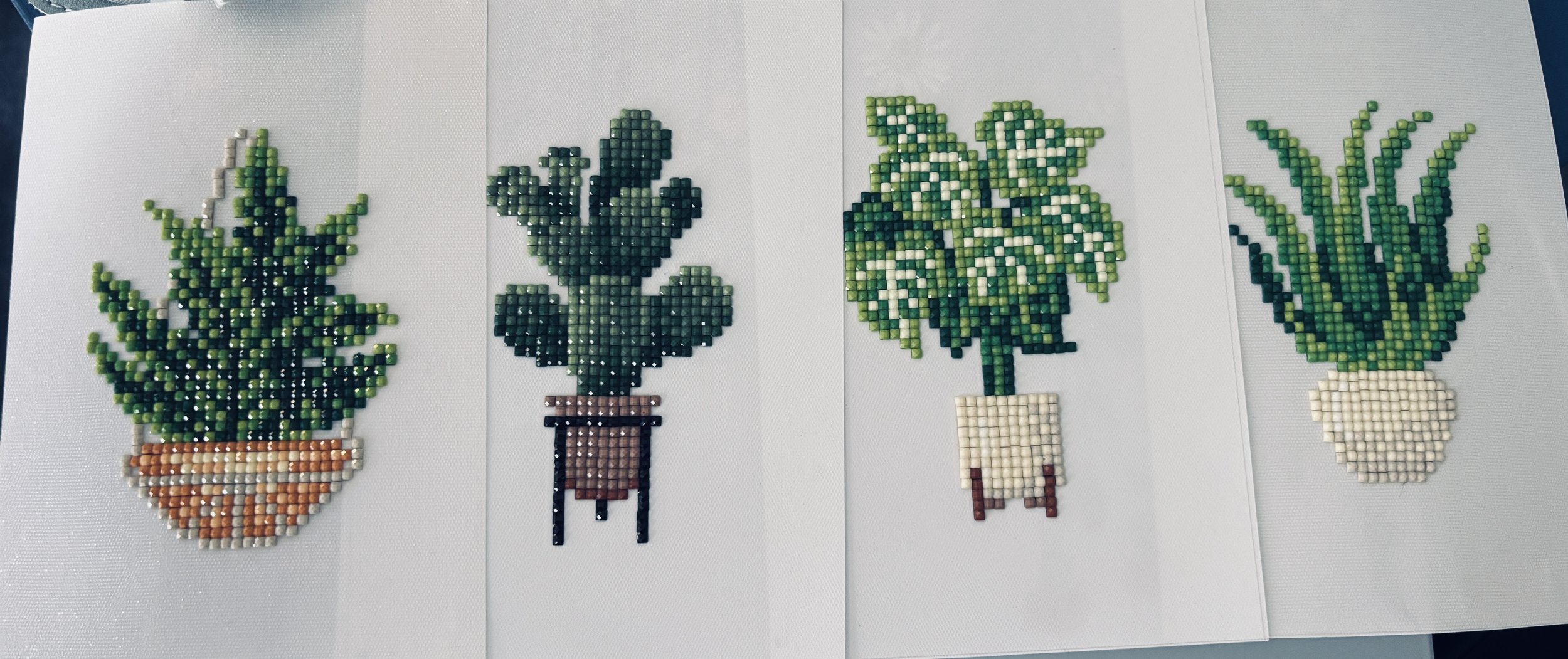
Quick recap: I'm spending 2026 trying a new hobby every month - not to master it, not to monetize it, just to play. January was puzzles (permission to pivot). February was coloring (permission to admit when "relaxing" feels like work). March? I'm taking color to a new dimension - literally.
Paint by Code, Not by Chaos
After February's coloring stress taught me that too much creative freedom overwhelms me, I decided March needed more structure. Enter: template painting. Diamond art and paint-by-numbers - both activities where someone else makes the creative decisions and you just... execute.
Sounded perfect for my puzzle-loving, solution-seeking brain.
I started with a PaintGem diamond art kit - 12 mini canvases, each about 4x6 inches. The concept: tiny resin "diamonds" (really just faceted plastic beads) that you place one-by-one onto a sticky canvas using a special pen tool, following a color-coded chart.
Meditative. Sparkly. Finite. What could go wrong?
Reality Check: Accessibility Edition
Here's what I wasn't expecting: the setup was not dyslexic-friendly at all. Nor was it for the mobility challenged.
Before even starting on a template, the kit required me to prep my materials by matching letter codes to numeric codes, and many were visually similar to each other - B and 8, O and 0, I and 1. Under anything less than perfect lighting, I was squinting at tiny codes trying to distinguish between colors that looked nearly identical.
Is this true for all diamond art kits? I don't know - this was my first one. But it taught me something important: when a hobby creates friction, that's not a personal failure. That's design.
Another issue? The “wax” and diamond “pen” were incredibly hard to mold/work. I found it much easier/smoother to use the tweezers to place each gem. This required some precision that someone with arthritis or dexterity issues would find very difficult.
I am fully aware that not all hobbies are built with all users in mind. And recognizing that a system doesn't serve you isn't being "bad at it" - it's valuable data about what actually works for your brain or your abilities. I'm extra sensitive to accessibility design issues. Even though my own disability is hearing-related, I recognize when hobbies create unnecessary barriers - whether for vision, mobility, or other challenges
The Focus Requirement I Didn't See Coming
Remember how I could do puzzles while watching TV or singing along to my 2000s best hits? Yeah, diamond art is not that.
The stickiness of the canvas means you really need to finish each piece in one sitting - or at least get far enough that you can cover it back up without losing progress. And the tiny, repetitive work demanded my full attention. Trying to watch a show in the background? Not successful. Music? Barely. In those instances, I preferred quiet - background noise just became a distraction.
These became full "zone out" sessions. Just me, the canvas, and hundreds of tiny plastic gems.
Relaxing, or not?
Different hobbies require different brain states. Puzzles let me multitask. Diamond art demanded I be present. Neither is better, but discovering what you need on any given day (background activity vs dedicated focus time) helps you choose the right hobby for your mood. I will say your seated position matters, at times I found myself hunched over the template and had to take stretch breaks to loosen up. The irony of not relaxing while trying to relax was not lost on me.
The "What do I do with this?" Problem
I finished all 12 mini pieces. They're pretty. They're sparkly (well, kind of - more on that in a minute). And now I have... 12 small diamond art pieces.
What do I do with them? I’ve got limited wall space and plenty of real plants already.
This is the reality of craft hobbies - they create stuff you might not need. Puzzles go back in a box. Coloring pages stayed in their book. And here's where the Permission Slip Method gets interesting: you don't need a use case before you start.
You have permission to make something just to make it. Permission to figure out what to do with it later. Permission to gift it, display it, upcycle it, or even toss it if it doesn't serve you.
I'm planning on taking them up a notch and really turning them into one of a kind art. And quite possibly listing some for sale on Facebook Marketplace.
Elevating the Template
The gems aren't as shiny as I wanted. So I'm researching sealers - probably Triple Thick Glaze Spray or Diamond Painting Sealer to give them that extra sparkle. However my first thought was my middle school hair glitter I used to wear on cheering days.
And then? I'm turning this template kit into a curated collection. I’ll Mod Podge with vintage napkins around coordinated photo mats. This will require some antique hunting and thrifting - might try to head to Goodwill this weekend. I’ve already been scoping out paper napkins for sale on Facebook Marketplace, Ebay, and Poshmark. Painted frames that tie the whole thing together. Maybe even sell the collection once it's done. I actually am really excited to take the template and run with it, using it as a starting point not the finished product.
To me, this is the sweet spot of creativity: following instructions while making it your own version.
Template painting gave me the structure I need (no color-coordination stress like February's coloring books). But I'm not just accepting the kit as-sold. I'm elevating it. Making it one-of-a-kind.
Some hobbies are consumed as-is. Others are starting points. And you have permission to decide which is which.
Paint-by-Numbers: Round Two
This weekend, I'm tackling paint-by-numbers. Same concept - follow the template - but with actual paint instead of plastic gems. I'm curious if the experience feels similar or if the medium changes everything. I’ve heard the painting in the lines can be challenge with bad brushes and I’ve not been shy about my inability to draw (or cut!) in a straight line. This could be an uncomfortable experience if I am honest.
Will I need the same zone-out focus? Will the letter-to-number coding be easier with paint colors? Will I feel the same satisfaction of seeing a finished product in one sitting? Progress posts coming to IG!
This Month’s Learnings:
March taught me several things:
Accessibility matters. Poor design isn't a personal failing. Some hobbies create unnecessary barriers, and recognizing that helps you choose what actually serves you.
Different hobbies need different brain states. Multitasking-friendly vs focus-demanding. Both valid. Choose based on what you need that day.
You don't need a plan for the output. Make things just to make them. Figure out the rest later. You don’t need an objective for all hobbies. Do them for their dopamine hit (and hopefully not a negative time “suck”!).
How you frame your time matters. "Time suck" versus "time well spent" isn't about the hobby itself - it's about how it makes you feel. Diamond art demanded hours of focus. Was that a time suck? No, because I felt satisfied, calm, and accomplished afterward. February's coloring? That felt like a time suck because perfectionism turned it into work. Pay attention to your own language. If you're calling it a "time suck," you probably need permission to quit.
Templates aren't limiting, consider them scaffolding. Structure can be freeing when you're not ready for total creative freedom. But you can still make it yours.
The finish line feels good (with caveats). One-sitting completions are satisfying, if you can dedicate that sitting. Some hobbies have built-in time pressure; others let you walk away. Know which you're signing up for.
Not all hobbies are consumed as-sold. You have permission to modify, enhance, and elevate the template into something that reflects your vision.